
Beginner’s Guide: How to Build an Audience Persona
Audience personas help you gain insight into prospective customers and influencers so you can create compelling, engaging content tailored to their needs. You want to spend some time on this step, otherwise your entire content marketing program could be a total bust. You want to be focused and deliberate in your content development and that…

Ashley Poynter
— Founder, Content Rewired11 min · Oct 17

On This Page
Audience personas help you gain insight into prospective customers and influencers so you can create compelling, engaging content tailored to their needs.
You want to spend some time on this step, otherwise your entire content marketing program could be a total bust. You want to be focused and deliberate in your content development and that requires a deep understanding of the people for whom you’re creating content. The idea is “tell, don’t sell” and to “tell” effectively, you need to understand what appeals to your audience.
Understanding Audience Personas vs. Buyer Personas
People often get buyer personas and audience personas confused. Buyer personas relate to sales goals whereas audience personas relate to your content marketing goals. With buyer personas, the focus is often on the conversion stage of the marketing funnel, whereas audience personas may relate to any stage in the marketing funnel (awareness, consideration, and conversion).
Here are a few other key differentiators:
- A buyer persona is typically created around someone who has decision-making capabilities, but an audience persona may include people beyond that role, including influencers of decisionmakers.
- A buyer persona is often created around someone who is actively seeking branded content to aid their decision, whereas an audience persona centers around someone seeking awareness- or interest-based content.
- A buyer persona targets someone who has decided to make a purchase, whereas an audience persona targets those who may be considering making a purchase.
The key here is to remember that these two types of personas are not necessarily mutually exclusive, nor is it necessary that they overlap. How these two types of personas interact will vary widely based on your business model and marketing strategy.
Building a Basic Audience Persona Template
Don’t shotgun it. It may be tempting to jump right into content creation, but your mantra should always be quality over quantity. Quality requires data and data requires research.
Personas are research-based representations of your ideal audience(s). Note, this may be – and usually is – plural. It can be tempting to pigeonhole your audience into one distinct box, but the truth is that people have different motivations, different goals, and different preferred content consumption methods. These should all be accounted for in your personas. Let’s map out the foundation of a basic audience persona template:
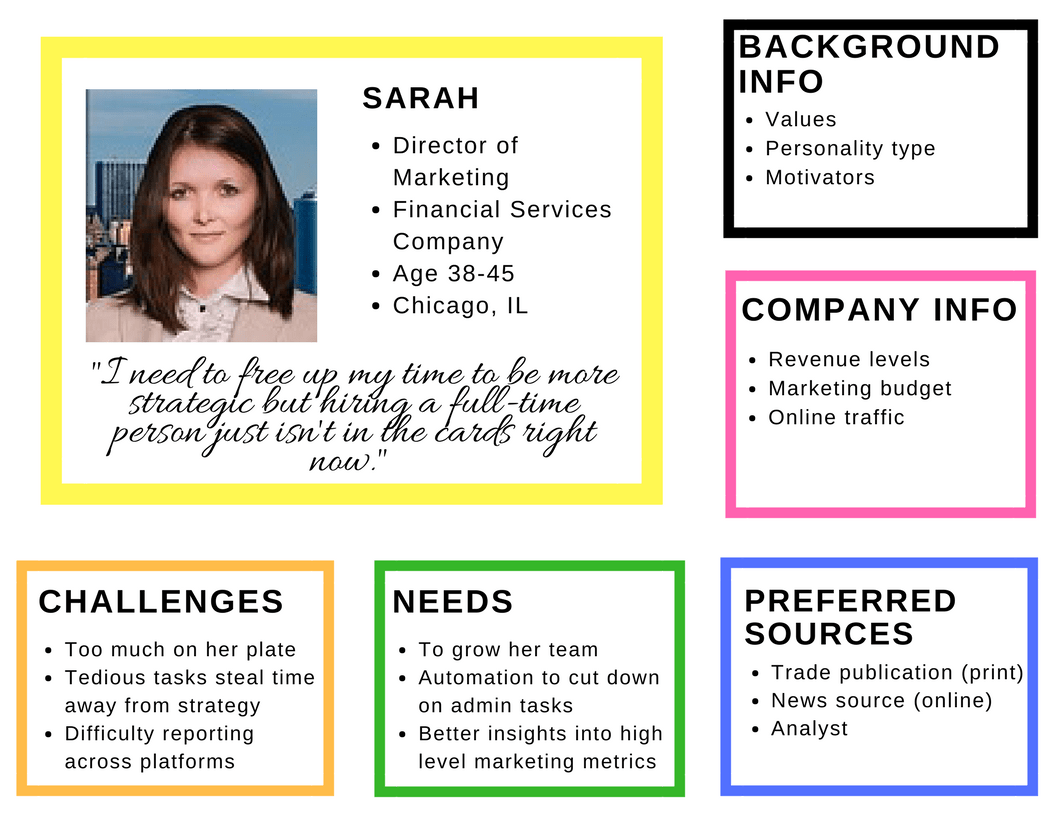
This is just the beginning. Your audience personas can get as detailed as you like them to be or feel is necessary. The more information you have about your target audience, the more precise your content marketing strategy can become. It’s also worth noting that starting out with this basic template is fine; you can always build in additional information as it becomes available and tweak your content marketing strategy accordingly.
How to Create an Audience Persona
Now that you have a framework for your audience persona, you need to fill it in with accurate information based on data. There’s no one right way to collect the information you need; in fact, your best bet is to cast a wide net and hone down relevant information from there.
Analytics
A great place to start is your own website’s analytics. Here, you’ll find a treasure trove of information, including where your visitors came from (geographically as well as referral sources), which types of articles they viewed the most, and how long they spent on different pages of your site. This information can be used to inform the types of sources from which they gather information, the types of topics they may be researching, and some demographic information.
Sales Team
Another great internal source of information is your own sales team. These people are the front lines of interaction with decision makers and they likely have some valuable insights about information gaps that may exist in the market. They may be able to provide a list of top questions that come up in sales presentations, popular objections that can be tied back to misinformation or lack of understanding, and top points of interest to prospects.
Your Audience
The most obvious place to garner insights into what your target audience is looking for is….your audience. Connect with your social fans and followers, customer service interactions, and current customers/clients to gather information that can feed your strategy. You can use tools like Google Forms or Typeform to create surveys and questionnaires to send to people. Hint: keep these items short and sweet and incentivize participation where possible.
It can be helpful to run through this audience persona checklist:
- Check Google Analytics to identify key demographic information about people visiting your site (gender, age)
- Audience > Demographics > Overview
- Check Google Analytics to identify what your audience is interested in
- Audience > Interests > Affinity Categories
- Check Google Analytics to identify what devices your audience prefers
- Audience > Mobile > Overview
- Gather information from current customers (how they heard about you, their content interests)
- Talk to sales to get insights about the type of people that buy from you
- Research your database – gather information from the social profiles, websites, and other online presences of the people in your database.
- Research trends, challenges, and solutions relevant to audience verticals
Not only does this set the stage for the type of content you will produce, but it also helps ideate on potential ways to organize content on your website. Many companies have a content hub or resource center that houses various white papers, case studies, checklists, how-to guides and other helpful content. Once that hub becomes big enough, it can be beneficial to segment some of that information by industry, challenge, and or media type.
This information will also be helpful in laying the groundwork for your promotion/distribution/amplification strategy as it will inform you where and when people prefer to consume content.
The point of audience personas is to help you identify with your target audience, understand their content/research needs, and figure out ways to provide the information they need in a helpful, compelling way. It positions you to be the best problem-solver and to use storytelling to build trust and relationships that can ultimately boost your bottom line.
How to Create a Fintech Audience Persona
Fintech audience personas are critical for content marketing success. It’s table stakes to understand who you are creating content for – and what they need and want.
Creating fintech audience personas can be more complicated than the average persona, as there are often purchasing committees, influencers, and other considerations to take into account. If you’re a B2B fintech organization, it’s important for you to understand exactly what your audience is looking for and how to add value.
What Do I Include in My Fintech Audience Persona?
Building an audience persona includes looking at several different facets of your prospective buyers:
- Overview
- Challenges
- Needs
- Information sources
- Background/company information
- Values
How Do I Get the Information?
Finding this information will require some research on your part. The good news is that you don’t have to go too far to start. Google Analytics, surveys your company may have already conducted, and your own inbox are all great places to glean valuable nuggets of information about your audience.
Google Analytics
The first place to turn for insights about your audience is Google Analytics. You can discover where your visitors are coming from, what type of content resonates with them, and which pages convert well.
A few quick reports to reference include:
- Check Google Analytics to identify key demographic information about people visiting your site (gender, age)
- Audience > Demographics > Overview
- Check Google Analytics to identify what your audience is interested in
- Audience > Interests > Affinity Categories
- Check Google Analytics to identify what devices your audience prefers
- Audience > Mobile > Overview
Your Inbox
While this one might be trickier to navigate, it shouldn’t be overlooked. Depending on your role, you may find that you have access to current customers’ thoughts, questions, and concerns via email. These items can all be used to build out a robust audience persona that outlines how your target audience thinks and what they value.
Surveys
You can use tools like Google Forms or Typeform to create surveys and questionnaires to send to people. Hint: keep these items short and sweet and incentivize participation where possible. In some cases, you may have already conducted surveys or other research, so be sure to include any relevant findings as you build out your audience persona.
Industry/Market Research
Industry and market research is a critical component of your audience persona. While qualitative research from your inbox, surveys, and other interviews is certainly helpful, it’s good to scrub that information against other quantitative data.
If you don’t have the budget to commission your own specific market research, see what other market and industry research may already be published. Look to industry analysts to see where their data can inform your personas. While personas are fictional representations of segments of your buyers, you want them to be as close to “real life” as possible. Leveraging quantitative data can help you do this.
What Are Other Considerations of a Fintech Audience Persona?
Creating a fintech audience persona chart with all of the information outlined above is a great starting point, but thoroughness is essential. As we mentioned in the introduction to this piece, fintech organizations (or companies selling to other fintechs) face complexities when it comes to effectively honing in on and reaching an audience.
You’ll want to take note of these factors and include them in your audience persona document where relevant. This could include things like:
- Personality type
- Influencers
- Other buyers
Personality Type
There are plenty of ways to go about identifying what type of personality your audience segment(s) have. Consider looking at Myers-Briggs Type Indicator (MBTI), DiSC, 16 Personality Factor Questionnaire, and more.
It’s important to recognize that, while you may be selling to one market segment or “title”, people are unique. The more you can zoom in on special characteristics – and use that information to make an impression on your audience – the more effective your content marketing will be.
The benefit of identifying the qualities, values, and other personality quirks of your target audience is that you can better speak their language when creating content. It’s a way of better understanding how the people you are creating content for are wired – putting you in a position to create content that will resonate with them and compel them to act.
Influencers
Influencers are important because they have the power to influence the purchase decisions of your target audience. For this reason, it may make sense for you to create content that speaks to this segment, even if they are not your direct decision-maker.
Alternatively, you might create content that speaks to concerns your target audience may have about their influencers’ opinions. The goal is to understand who has your audience’s ear – and to ensure that you’ve addressed any concerns those people might raise.
Other Buyers
In many cases, B2B fintechs are selling to a purchasing committee. When multiple parties are involved in purchasing decisions, it’s key to address everyone’s questions and concerns. Identifying other buyers – or secondary buyers – can help you address concerns and questions and further segment your audience into more granular personas.
Telling the Right Stories to the Right People
Creating thorough audience personas go a long way in informing your content marketing strategy. They can guide the type of content you produce, the topics you cover, and how you organize content on your owned channels. Beyond that, they can also provide valuable information about how to distribute and promote content and marketing campaigns.
By identifying with and understanding your target audience and their content needs, you can create content that adds value, serves their needs, and provides helpful information. Fintech audience personas also play a foundational role in creating narratives and stories that will impact your audience. This is critical for fintechs who can lean on storytelling not only to educate but to build trust and credibility with their audiences.
Beginner’s Guide: How to Build an Audience Persona – FAQ’s
Ashley Poynter
Ashley is the Founder of Content Rewired, a fintech content practice built on nearly twenty years inside payments, treasury, and fintech SaaS. She writes about editorial leadership, AI-enabled content production, and the discipline that separates B2B fintech marketing that compounds from the work that just publishes.
-

CONTENT MARKETING STRATEGY
Content Marketing Strategy for Tech Audiences
-

CONTENT MARKETING STRATEGY
How to Build a Fintech Editorial Strategy Your SMEs Will Actually Follow
-

CONTENT MARKETING STRATEGY
Sales Enablement Content for Technical Buyers: What Actually Works
If this was useful, the newsletter is too.
One essay every other week. No roundups, no engagement bait. Just one substantive argument about fintech content marketing.