

Table of Contents
Most fintech companies don’t wake up one morning and decide to create a messy content ecosystem. It happens slowly. A product launch here. A regulatory update there. A new ICP layered on top of an old one. Over time, running a fintech content audit comes secondary to content creation.
That’s where a fintech content audit becomes less of a “marketing exercise” and more of a business necessity.
I’ve seen audits uncover hidden growth levers—high-intent pages buried three clicks deep, white papers quietly driving pipeline, blog posts ranking for keywords no one realized mattered. I’ve also seen them surface real risks: obsolete product claims and content that signals the wrong buyer altogether.
This guide walks through how to run a fintech content audit that actually informs decisions. Not a vanity exercise. Not a spreadsheet for its own sake. A structured, practical approach that helps you decide what to fix, what to scale, what to retire, and what to build next.
What a Fintech Content Audit Is (and What It Is Not)
Let’s level-set.
A fintech content audit is a systematic review of all customer-facing content—across marketing and sales enablement—to evaluate performance, accuracy, relevance, and strategic alignment.
It is not:
- A simple SEO crawl
- A traffic-only review
- A one-time cleanup project
In fintech, content carries more weight. It shapes trust. It signals compliance maturity. It frames risk. And increasingly, it influences buying committees long before sales gets involved.
A strong audit answers four questions:
- Is this content accurate, compliant, and up to date?
- Is it attracting the right audience?
- Is it moving buyers forward—or just filling space?
- Does it reflect where the business is going, not where it was?
If your current content can’t answer those questions confidently, you don’t need more output. You need clarity.
When You Should Run a Fintech Content Audit
There’s no “perfect” cadence, but there are clear triggers. If any of these sound familiar, it’s time.
- You’ve pivoted ICPs or vertical focus in the last 12–18 months
- Product capabilities have evolved faster than your messaging
- Organic traffic is flat, but rankings haven’t collapsed
- Sales is creating its own decks because marketing assets feel outdated
- Compliance or legal has raised concerns about published content
- You’re planning a rebrand, website refresh, or major campaign
Audits are especially critical before expansion—new geographies, new regulatory regimes, or new buyer personas amplify the cost of outdated or misaligned content.
Step 1: Define the Scope of Your Fintech Content Audit
Before you touch a spreadsheet or crawl a site, decide what you are auditing—and why.
This sounds obvious, but it’s where most teams stumble. They try to audit everything at once and end up overwhelmed, under-resourced, and underwhelmed by the outcome.
Decide What Content Types to Include
At minimum, most fintech content audits should include:
- Website pages (product, solutions, pricing, compliance, resources)
- Blog posts and thought leadership articles
- Gated assets (white papers, reports, eBooks)
- Case studies and customer stories
- Pillar pages and SEO landing pages
Depending on maturity, you may also include:
- Sales decks and one-pagers
- Partner content and co-marketing assets
- Help center or educational content
- Webinar recordings and video transcripts
If this is your first audit, start with owned, public-facing content. That’s where risk and opportunity are most visible.
Clarify the Business Objective
A fintech content audit without a business lens turns into busywork. Be explicit about what success looks like.
Common objectives include:
- Increasing qualified organic traffic
- Improving conversion rates across the funnel
- Reducing compliance risk
- Aligning content to a refined ICP
- Supporting a new GTM motion or vertical
Your objectives will shape what KPIs you prioritize and how aggressively you recommend change.
Step 2: Build a Complete Content Inventory
This is the unglamorous part, but it’s foundational.
Create a single source of truth that lists every piece of content in scope. Most teams use a spreadsheet or Airtable. The tool matters less than consistency.
What to Capture in Your Fintech Content Audit
At a minimum, include:
- URL or asset name
- Content type
- Topic or theme
- Primary audience or persona
- Funnel stage (awareness, consideration, decision)
- Publish or last updated date
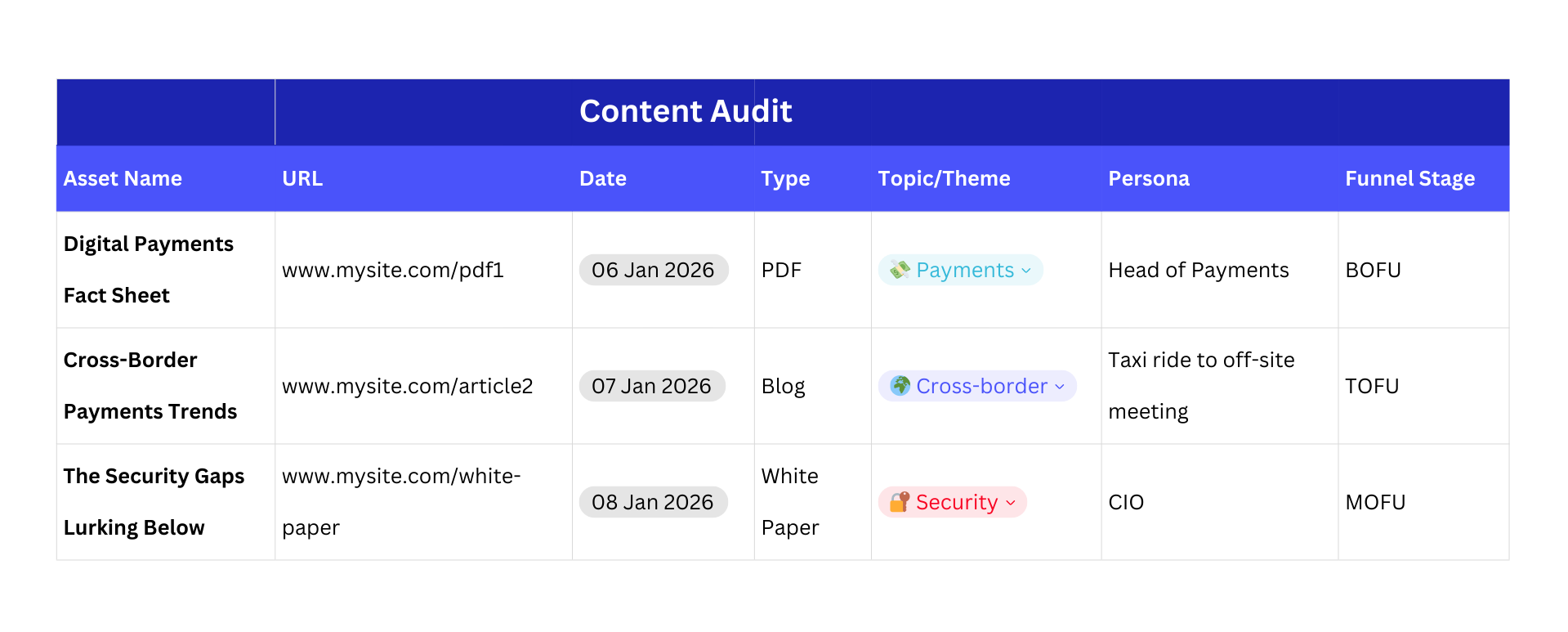
Then layer in performance and quality indicators (we’ll get to those next).
For large sites, use tools like Screaming Frog or Sitebulb to crawl URLs and export metadata. For blogs and gated assets, manual review is often unavoidable—and worthwhile.
This step alone often reveals patterns. Clusters of content around outdated features. Over-indexing on awareness with little bottom-funnel support. Multiple pages competing for the same keyword.
Those patterns are signals. Pay attention.
Step 3: Performance KPIs to Include In Your Fintech Content Audit
Traffic alone is not a strategy. Especially in fintech, where buying cycles are long and audiences are selective.
A smart fintech content audit looks at performance through multiple lenses.
SEO and Visibility KPIs
These tell you whether content is discoverable.
- Organic sessions over time
- Keyword rankings (primary and secondary)
- Impressions and click-through rate (from Google Search Console)
- Indexation issues or cannibalization
High impressions with low CTR often point to weak positioning or unclear value propositions—an easy win if addressed.
Engagement and Quality Signals
These indicate whether the right audience is engaging.
- Average time on page
- Scroll depth or engagement rate
- Bounce rate (interpreted carefully)
- Pages per session
A “high bounce rate” isn’t always bad. Some buyers come for a specific answer and leave satisfied. Look for patterns rather than absolutes.
Conversion and Pipeline Influence
This is where many audits fall short—but it’s where credibility is earned.
- Form fills or demo assists by page
- Assisted conversions
- Content-to-opportunity influence (if available)
- Lead quality indicators
Even directional data is useful. If a supposedly top-of-funnel blog consistently appears in closed-won journeys, that’s a signal worth amplifying.
Risk and Accuracy Indicators
Unique to regulated industries, but non-negotiable.
- Mentions of outdated regulations
- Deprecated product features
- Claims that may require substantiation
- Inconsistent compliance language
If legal or compliance needs to be involved later, flag content early. Audits are a chance to prevent future fire drills.
Step 4: Assess Strategic Fit, Not Just Performance
Some content performs well—and still needs to change.
A fintech content audit should go beyond optimizing what already works. It should ensure content reflects who you are selling to now, including their updated preferences.
Questions to Ask During Review
For each asset, ask:
- Is this written for our current ICP?
- Does it reflect our current positioning and differentiation?
- Does it align with our regulatory posture and risk tolerance?
- Does it move the buyer forward—or stall them?
You’ll find content that ranks well but attracts the wrong audience. Content that sounds polished but says nothing. Content that made sense pre-pivot but now creates confusion.
Be honest. Sentimentality has no place here.
Step 5: Classify Content with Clear, Actionable Labels
Once performance and fit are assessed, every piece of content should fall into one of four buckets:
- Keep and scale: High-performing, on-strategy content. Refresh lightly, promote more aggressively, and use as a model.
- Update and optimize: Solid foundations with outdated data, weak framing, or missed conversion opportunities.
- Consolidate: Multiple assets covering similar ground. Merge into a stronger, authoritative piece.
- Retire: Low-value, risky, or irrelevant content. Redirect URLs where appropriate.
Avoid vague labels like “needs work.” Precision drives action. And remember: retiring content is often as important as creating new content. Silence is better than misinformation.
Step 6: Tools to Use for a Solid Fintech Content Audit
Tools support audits. They don’t replace judgment.
Here’s a practical stack most fintech teams can rely on.
Core Tools
- Google Analytics / GA4 – Traffic, engagement, and conversion data
- Google Search Console – Search visibility and keyword insights
- Screaming Frog or Sitebulb – Site crawls and technical insights
- Ahrefs, Semrush, or Moz – Keyword performance and competitive context
Supporting Tools
- Hotjar or FullStory – Behavioral insights on key pages
- CRM or marketing automation platform – Pipeline influence
- Content management system – Metadata, update history
In short, the goal is to generate clearer decisions.
Step 7: Translate Fintech Content Audit Insights into an Updated Content Strategy
This is where most audits quietly fail.
Teams produce a beautiful spreadsheet, present it once, and move on. The audit becomes a snapshot when it should be a catalyst.
A strong fintech content audit should directly inform strategy across four areas.
1. Editorial Priorities
Use audit findings to decide:
- Which topics deserve deeper investment
- Which narratives need reframing
- Which content types actually influence buyers
If bottom-funnel content consistently assists conversions, that’s a signal to rebalance editorial resources.
2. SEO and Information Architecture
Audits often reveal structural issues:
- Overlapping pages competing for the same keywords
- Gaps in high-intent queries
- Pillar opportunities that don’t yet exist
Use this to rebuild topic clusters and internal linking with intention, not guesswork.
3. Messaging and Positioning
Patterns emerge quickly in audits:
- Overuse of generic fintech language
- Under-articulation of risk mitigation
- Feature-heavy copy with little outcome framing
This is your chance to sharpen how you talk about value, trust, and differentiation.
4. Governance and Cadence
Finally, decide how you prevent this from happening again.
Who owns content accuracy?
How often is content reviewed?
What triggers updates or removals?
Content governance = brand protection.
Step 8: Build a Realistic Execution Roadmap
An audit without follow-through is an expensive inventory exercise.
Turn insights into a phased plan:
- 30-day fixes: High-impact updates, compliance risks, quick SEO wins
- 90-day projects: Consolidations, rewrites, new pillar pages
- Ongoing initiatives: Editorial shifts, governance processes, performance tracking
Tie each initiative back to a business objective. This keeps momentum when priorities compete.
What a Good Fintech Content Audit Delivers
When done well, a fintech content audit delivers more than cleanup.
It delivers:
- Clear visibility into what actually drives value
- Reduced regulatory and reputational risk
- Stronger alignment between marketing, sales, and product
- A content strategy grounded in reality, not assumptions
Most importantly, it restores confidence. Confidence that your content reflects your expertise. Confidence that it supports buyers at every stage. Confidence that what’s published today won’t become a liability tomorrow.
Fintech Content Audits Are Ground Zero For Trust Building
Fintech buyers are skeptical by default. They read closely. They remember inconsistencies. And they rarely forgive sloppy messaging.
A fintech content audit is your opportunity to meet that scrutiny head-on—to sharpen, simplify, and strengthen how your company shows up in the market.
Not louder. Just clearer.
And in fintech, clarity compounds.
Tap Into the Best Tips On Running a Fintech Content Audit?
Check out the following tools and playbooks to fine-tune your fintech content marketing strategy this year:
- Answer Engine Optimization Playbook
- Fintech Demand Generation Playbook
- Fintech Customer Acquisition Playbook
- Knowing When to Hire a Fintech Content Marketing Agency
- B2B Fintech Lead Generation & Marketing During a Recession
- Fintech Marketing Playbook
- Payments Thought Leadership Playbook
- The Financial Marketer’s Guide to Content Marketing