
Table of Contents
In 2025, AI has evolved from a futuristic concept to an operational necessity. Nowhere is this more evident than in the world of B2B payments, where complex buying cycles and high-value decision-making require targeted, data-backed marketing strategies. At the heart of this evolution lies AI-driven content marketing — a shift from guesswork to precision, from mass outreach to hyper-personalization.
AI is not replacing marketers. It’s redefining how they work: removing inefficiencies, providing real-time insights, and helping them produce and distribute content with unprecedented speed and accuracy. For B2B payments companies, where competition is fierce and buyer attention is fleeting, AI-driven content marketing is more than an edge — it’s the foundation of modern digital engagement.
AI-Driven Content Marketing is the Future…and the Now
B2B marketing was once dominated by static content calendars, SEO guesswork, and spray-and-pray email campaigns. Companies produced whitepapers, blogs, and webinars, pushing the same assets to every lead, regardless of role, pain point, or buying stage. This “one-size-fits-all” model is now obsolete.
Today’s B2B buyer expects relevance at every touchpoint. A treasury manager exploring fraud prevention strategies doesn’t want to sift through generalized thought leadership. They want specific, personalized insights — and they want them now.
Enter AI. With machine learning, natural language processing, and predictive analytics, content marketers can now produce the right message for the right person at the right time — with a fraction of the manual effort.
The Core Pillars of AI-Driven Content Marketing
The adoption of AI in B2B marketing isn’t just a matter of convenience — it’s a shift in the foundation of how companies engage with prospects, deliver value, and drive revenue. In the high-stakes world of B2B payments, where deals often involve multiple stakeholders, long sales cycles, and complex value propositions, traditional content strategies simply don’t cut it anymore.
Buyers expect relevance, speed, and personalization — and AI delivers on all three. From ideation to execution, AI enables marketing teams to make smarter decisions, create content that speaks directly to distinct personas, and optimize every piece of communication in real time.
But AI isn’t just one tool or tactic. It’s an entire ecosystem of capabilities working together to eliminate inefficiencies and amplify impact. To understand just how deeply AI is reshaping the marketing function in B2B payments, it helps to break down the core areas where AI is driving the biggest shifts — and how each one contributes to a smarter, faster, more effective content strategy.
Let’s take a look at the foundational pillars of AI-driven content marketing and explore how they’re changing the game for forward-thinking fintech marketers.
1. Predictive Content Planning: Stop Guessing, Start Knowing
Historically, content ideation involved brainstorming, competitor research, and intuition. Marketers would hope their blog post on “Cross-Border Payments in 2024” would gain traction — but hope isn’t a strategy.
AI flips the script. Tools like MarketMuse, Frase, and ClearScope ingest massive datasets — search trends, keyword gaps, competitor content, user intent — and surface topics with the highest potential to rank, convert, and engage.
Example:
AI identifies that “AI fraud detection in B2B payments” has seen a 400% spike in search volume over the past 90 days. That’s not just a suggestion — that’s your next content priority.
Impact:
- Higher ROI per asset.
- Faster time-to-rank in search.
- Content aligned with real-time market demand.
2. Hyper-Personalization at Scale
In B2B, a single sales cycle might include CFOs, compliance officers, product leads, and IT managers — all with different concerns. Generic messaging is a non-starter.
AI-powered personalization engines like Mutiny, Dynamic Yield, and Optimizely change the content experience based on a visitor’s role, company size, behavior, and past interactions.
✅ Example:
- A CFO visiting your homepage sees: “How to Improve ROI in Treasury Operations with AI.”
- An IT lead from the same company, one minute later, sees: “Secure, Scalable Payment Integrations for Complex Tech Stacks.”
Impact:
- More relevant content.
- Increased time on page and conversion rate.
- Better alignment with buyer journeys.
3. Automated Content Generation: First Drafts, Fast
One of the most practical benefits of AI is speed. Tools like ChatGPT, Jasper, and Copy.ai can now generate high-quality first drafts for everything from product pages to thought leadership blogs.
It’s not about letting AI write for you — it’s about letting AI get you 70% of the way there, so your team can focus on strategy, storytelling, and brand voice.
✅ Use Cases:
- Turn a webinar transcript into a polished blog post.
- Convert a case study into a LinkedIn thread.
- Repurpose a whitepaper into multiple email nurture sequences.
Impact:
- Faster content velocity.
- More consistent output.
- Greater content repurposing with minimal effort.
4. Smarter Lead Nurturing: Move Prospects Through the Funnel with Less Friction
B2B payments sales cycles are long and complex. AI helps shorten that path.
With AI-powered CRMs and marketing automation platforms (think HubSpot, Salesforce Einstein, or 6sense), marketers can score leads in real-time, segment audiences dynamically, and automate content delivery based on behavior and intent.
Example:
- A lead downloads a fraud prevention guide.
- AI assigns them a “high fraud interest” score.
- They are enrolled into a nurture stream with case studies, product demos, and ROI calculators specific to fraud protection tools.
Impact:
- Higher lead-to-opportunity conversion rate.
- Reduced manual segmentation.
- Personalized journeys at scale.
5. AI-Enhanced Visual & Video Content
Visual content is increasingly essential — especially for explaining complex B2B payments workflows. But not every team has access to video editors or design resources.
AI tools like Pictory, Synthesia, and Lumen5 help teams create:
- Text-to-video explainers.
- Personalized product demos.
- AI avatars for lead outreach.
Example:
Use Synthesia to create a video explainer titled “How Our AI-Powered B2B Payments Platform Prevents Fraud,” featuring a digital avatar delivering a custom message based on audience segment.
Impact:
- Increased video output without increasing headcount.
- Lower production costs.
- More engaging, multimedia-rich content experiences.
Essential AI Tools for B2B Payments Marketers
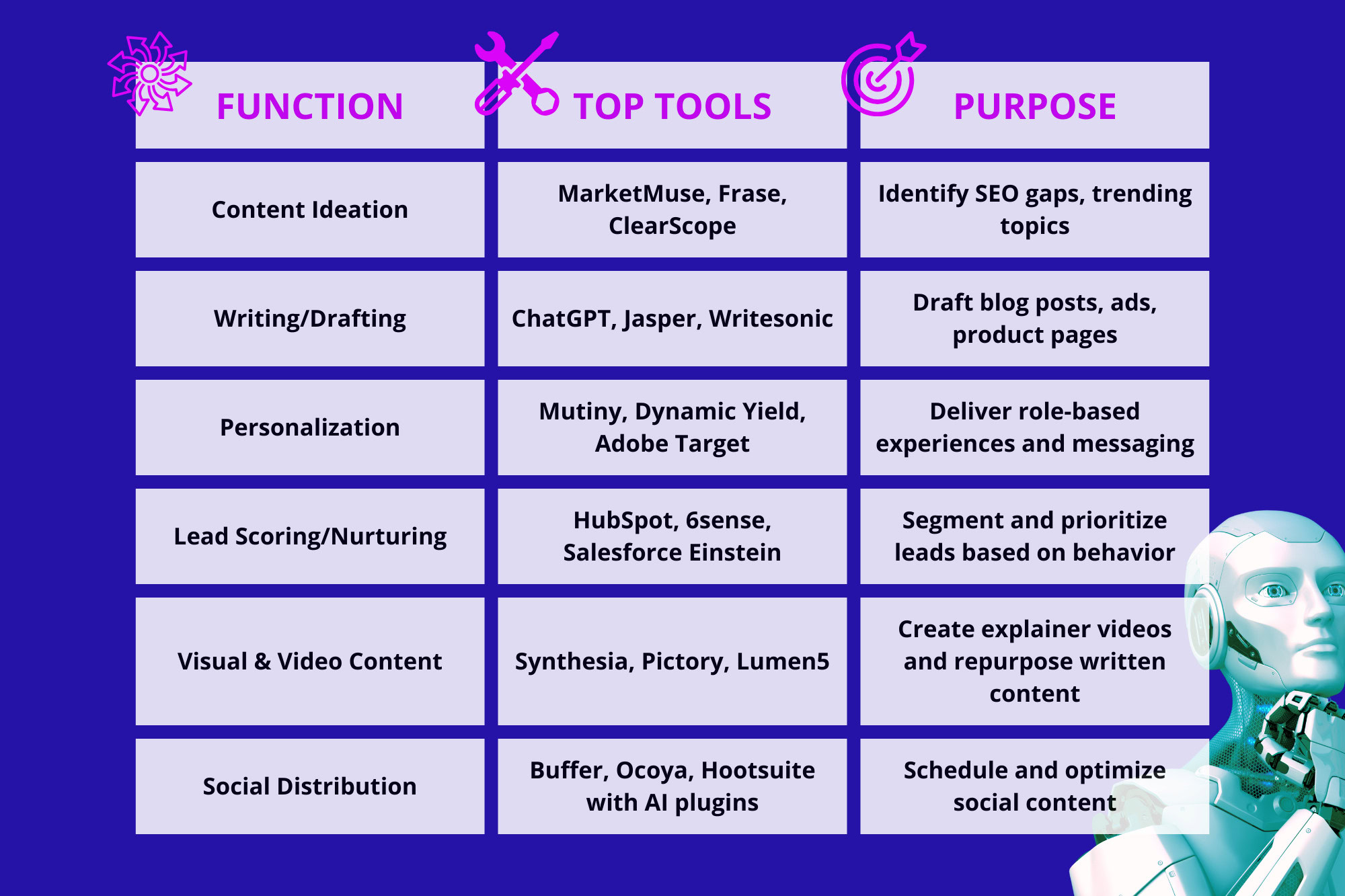
AI-driven content marketing isn’t just about strategy — it’s about execution. And execution depends on having the right tools in your stack.
In B2B payments, complexity is the norm and buyer expectations are higher than ever. This means choosing the right AI-powered platforms can make or break your content strategy. Whether you’re focused on improving content ideation, accelerating production, personalizing the user journey, or optimizing lead nurturing, the right tools don’t just streamline the process — they elevate the quality, consistency, and impact of your marketing efforts.
But the AI landscape is vast and evolving rapidly. With hundreds of platforms promising smarter workflows and better results, it’s important to understand which categories of tools are most relevant to your goals — and how to evaluate them in the context of your team’s size, needs, and existing tech stack.
Below is a breakdown of the essential AI tools every B2B payments marketer should consider — grouped by function and focused on solving real marketing challenges in a data-driven, scalable way.
Measuring Success in AI-Driven Content Marketing
Just because AI makes content faster and easier to produce doesn’t mean marketers can take a hands-off approach to performance. In fact, the opposite is true. As output increases and personalization deepens, measuring the effectiveness of every piece of content becomes even more critical — especially in a space like B2B payments, where the stakes are high and buyer journeys are complex.
Tracking the right metrics allows you to fine-tune your content engine, optimize spend, and make strategic decisions grounded in data — not assumptions. Fortunately, most AI-powered platforms come with built-in analytics, offering real-time visibility into how your content is performing across channels and personas.
Key Metrics to Track:
- Content Engagement: Monitor scroll depth, time on page, bounce rates, and interaction rates to assess how engaging your content really is.
- Conversion Rates by Persona: See which audience segments are responding best to specific types of content or messaging.
- Lead Scoring Accuracy: Use AI models to evaluate how well your lead scoring aligns with actual buyer behavior and intent.
- Sales Cycle Length (Post-Personalization): Measure whether AI-personalized experiences are accelerating your path from awareness to closed deal.
- Cost-per-Content-Asset: Analyze how AI is impacting your content production costs over time — especially when compared to manual workflows.
- SEO Performance: Track keyword rankings, click-through rates (CTR), backlink acquisition, and organic traffic growth to evaluate long-term discoverability.
With AI tools offering built-in analytics dashboards, teams can adjust content strategy in near real-time — something that was nearly impossible just a few years ago.
What AI Can’t (and Shouldn’t) Do
As impressive and transformative as AI-driven content marketing is, it’s important to remember that AI is a tool — not a replacement for human creativity, judgment, or strategy. While AI can supercharge execution and scale your efforts, it still relies on human marketers to guide the vision, define the voice, and ensure ethical integrity.
In fact, one of the biggest risks with over-relying on AI is losing the very thing that makes your brand unique: your point of view, your values, your voice, and your ability to connect with people on a deeply human level.
AI is here to assist, not to lead. And there are still several areas where human marketers play an irreplaceable role.
Don’t Outsource:
Strategy and Positioning:
AI can generate ideas and analyze market data, but it doesn’t understand your competitive landscape, your business goals, or your customers at the emotional level required to shape true brand strategy. That responsibility belongs to your leadership and marketing team.
Tone and Voice Calibration:
While AI can mimic tone to an extent, only your team knows the nuances of how your brand should sound — whether it’s sharp and authoritative, warm and conversational, or highly technical with a human touch. Consistency here builds trust.
Emotional Storytelling:
Great content connects because it tells a story people can relate to. AI can identify patterns in language, but it can’t replicate the depth of human emotion, vulnerability, or the kind of insight that comes from real experience. And in B2B payments — where trust and credibility are everything — this matters.
Ethical Considerations:
AI pulls from massive data sets, but it doesn’t understand nuance, bias, or misinformation in the same way a human does. Every AI-generated asset should be reviewed with a critical eye to ensure accuracy, compliance, and alignment with your brand’s values.bias.
Think of AI as a powerful intern with superhuman speed. It can write, plan, and analyze — but it still needs your leadership.
The Competitive Advantage of AI-Driven Content Marketing for B2B Payments Firms
In a niche as complex and competitive as B2B payments, AI-driven content marketing is no longer optional — it’s the new baseline.
Companies using AI effectively are:
- Launching campaigns faster.
- Closing deals quicker.
- Attracting higher-quality leads.
- Outranking competitors in search.
- Delivering more value per touchpoint.
If your competitors are using AI and you’re not, they’re not just beating you on speed — they’re beating you on relevance, personalization, and precision.
AI-Driven Content Marketing: Adopt Early or Fall Behind
AI isn’t a trend. It’s infrastructure. And for B2B payments companies, leveraging AI-driven content marketing is essential for sustainable growth.
Whether you’re just starting or already experimenting with tools, now is the time to invest in AI education, platform selection, and process integration. The sooner your team embraces the AI-powered future, the sooner you’ll see real results — in content output, lead quality, and revenue.
Want More Top Tips on AI-Driven Content Marketing?
Nice! We have some additional resources that might help you round out your fintech marketing program:
- Fintech Demand Generation Playbook
- Fintech Customer Acquisition Playbook
- Knowing When to Hire a Fintech Content Marketing Agency
- B2B Fintech Lead Generation & Marketing During a Recession
- Fintech Marketing Playbook
- Payments Thought Leadership Playbook
- The Financial Marketer’s Guide to Content Marketing